
Ajay Banga was on Wednesday appointed the next president of the World Bank, becoming the first-ever Indian-American to head the global financial institution which said it looks forward to working with him at a time when it's tackling the toughest development challenges facing developing countries. "The executive directors of the World Bank today selected Ajay Banga as president of the World Bank for a five-year term beginning June 2, 2023," the bank said in a press statement. In February, President Joe Biden announced that the US would be nominating Banga, 63, to lead the World Bank because he is "well equipped" to lead the global institution at "this critical moment in history."

Applicants for Indian citizenship under the Citizenship (Amendment) Act 2019 (CAA) can submit any of nine documents, including valid or expired passport, ID cards and land tenancy records, to prove he or she is a national of Afghanistan or Bangladesh or Pakistan.

The ongoing second quarter earnings, movement of oil benchmark Brent crude and the uncertainty in the Middle East would dictate terms in the domestic markets this week, analysts said. Furthermore, the activities of Foreign Institutional Investors (FIIs) will also influence trading in the markets. "A slew of earnings reports from heavyweights expected this week will significantly impact market direction.

IndiGo share price today: IndiGo share price fell as much as 4.8 per cent to a low of Rs 4,275 per share on the BSE in Monday's intraday trade as investors booked profit in the stock post a its April-June quarter (Q1) results for financial year 2024-25 (FY25). The stock ended 1.36 per cent lower at Rs 4,430 as against a 23-points gain in the benchmark BSE Sensex. The selling also got exacerbated as the management commentary, post Q1FY25 results, highlighted that inflationary pressure could likely dent July-September (Q2FY25) performance.

From the Sensex basket, Sun Pharma, Maruti, Power Grid, Titan, JSW Steel, Tech Mahindra, Larsen & Toubro and State Bank of India were the major laggards. Tata Motors, Tata Consultancy Services and Nestle were the gainers.

Portfolio investors based out of the US and other countries with which India does not have favourable tax treaties will have to pay a 15 per cent tax on their derivative transactions, after the Budget decided to classify income from all foreign portfolio investment as capital gains.

Macroeconomic data announcements, global trends and trading activity of foreign investors would guide momentum in the equity market this week, analysts said. Markets ended a five-week losing streak and gained nearly a per cent last week, helped by a sharp rebound on Friday. Last week, the BSE benchmark jumped 500.65 points or 0.77 per cent and the Nifty gained 169.5 points or 0.87 per cent.
Postings to places at an altitude above 1,000 metres but less than 1,500 metres, between 1,500 and 3,000 metres, and above 3,000 metres entail different rates of allowances -- the higher the location, the bigger the allowance, reveals Tamal Bandyopadhyay.

Before considering reducing the freedom of private investors in the derivatives market, we need to check if the maladies in markets elsewhere exist in India, says Susan Thomas.
After a positive opening, the 30-share BSE Sensex suddenly faced selling pressure in late-afternoon trade. It finally settled just 5.67 points, or 0.01 per cent, lower at 39,586.41.

Benchmark equity indices ended marginally higher on Thursday, trimming most of their intra-day gains, as investors turned cautious ahead of the quarterly results of IT behemoths TCS and Infosys later in the day. Announcement of the US inflation data and domestic macroeconomic numbers also forced investors to remain on the sidelines. The 30-share BSE Sensex climbed 63.47 points or 0.09 per cent to settle at 71,721.18.

Equity markets this week will be largely guided by trends in global stocks, foreign funds' trading activity and progress of monsoon, analysts said. Investors will also track the movement of rupee against the US dollar and crude oil prices. Benchmark indices Sensex and Nifty closed at fresh lifetime highs on Friday.

'We have to keep a watch because India-Sri Lanka has a history that whenever there has been a change in government, either the connectivity projects have been questioned or cancelled or revived.'

Trading in the equity market this week will be highly influenced by a host of important triggers, with quarterly earnings from IT majors TCS, Wipro, and domestic inflation and IIP data taking the centre stage in dictating the movement in equities, analysts said. Besides, global factors and trading activity of foreign investors will also drive markets. "We are approaching the first quarter earnings season, with HCL Tech, TCS and Wipro set to report their earnings this week.

Among the Sensex firms, Adani Enterprises and Adani Ports sustained their gaining momentum and traded higher by 4.40 per cent and 4.37 per cent, respectively. BPCL, Axis Bank, Mahindra & Mahindra and SBI were the other major gainers. On the other hand, HCL Tech, Infosys and Bajaj Auto traded in the negative zone with a loss of up to 1.54 per cent.
Rising outgo towards clearing and settlement fees has led to an altercation between the BSE and the National Stock Exchange of India (NSE), with the latter striking down the former's request to lower the charges. NSE said it has no plans to restructure the same and that it will continue with the pricing defined under the interoperability framework. The interoperability framework, introduced in 2019, allows trades executed on any of the exchanges to be settled or cleared at either of the two clearing corporations -- NSE Clearing (NCL) or Indian Clearing Corporation (ICCL), fully-owned by the NSE and the BSE, respectively.

'If you see another 1000-point correction, people may start panicking.'

Among the Sensex firms, Infosys, Tech Mahindra, HCL Technologies, Tata Consultancy Services, Wipro and JSW Steel were the major gainers during the morning deals. Nestle, Bharti Airtel, Axis Bank ITC were among the laggards.
Among the Sensex firms, Larsen & Toubro, Bharti Airtel, HCL Tech, Tata Motors, Sun Pharma and Tata Steel were the major gainers. On the other hand, Nestle, Asian Paints, Bajaj Finserv, HDFC Bank and Axis Bank were among the laggards.

The Securities and Exchange Board of India (Sebi) has proposed that at least 10 per cent of corporate bond market trades by foreign portfolio investors (FPIs) should be done on the request for quote (RFQ) platform. At present, most trades in the corporate bond market are over-the-counter (OTC), creating a lot of opacity. The markets regulator has been nudging debt market participants such as mutual funds (MFs), alternative investment funds (AIFs) and brokers to use the RFQ platform to boost secondary market liquidity and transparency.
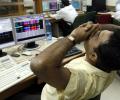
Wipro was the biggest loser among Sensex firms, sliding 2.32 per cent, followed by HDFC Bank, Power Grid, UltraTech Cement, ITC, ICICI Bank and Tata Motors. IndusInd Bank, Maruti, State Bank of India, Mahindra & Mahindra, Asian Paints and Bajaj Finserv were among the gainers.

From the Sensex pack, JSW Steel, Tata Steel, NTPC and UltraTech Cement emerged as major winners, closing the day with a gain of up to 3.33 per cent. On the other hand, Asian Paints, ITC, L&T and SBI were the laggards, ending the session up to 3.95 per cent lower. Of the 30 Sensex stocks, 14 closed the day in green, while on the 50-stock index Nifty 25 scrips ended with gains.

Debroy worked as a consultant in the Department of Economic Affairs in Finance Ministry.

"China creeps towards hegemony in Asia, threatens India's borders, and treats other countries as junior partners, Indian-American Congressman Ro Khanna said.

FIIs pump in $1.4 billion in March, after pulling out $2.9 billion in Jan-Feb.

Debates on changing the name of India to Bharat continue to spark a crisis of identity without answering moot questions that stare us in the face. Ramesh Menon asks a few of those questions that do not have easy answers.

The RBI cracked down on offshore foreign exchange trading by Indians through online trading websites.

Dealers said the sharp recovery of the rupee was because of restrictions imposed by the RBI on forward trading in the local currency by foreign institutional investors and traders, besides the cap fixed on banks' exposure to the forex market.

The behaviour of the foreign institutional investors is gauged from the numbers put out by the exchanges and regulators.


The new regulations leave registration capital requirements for wholly foreign-owned banks unchanged
Investor sentiment got a big push after Brent crude, the international benchmark, dropped below the USD 73-mark to quote at a seven-month low of USD 72.65 by falling 3.48 per cent, traders said.

On the Sensex chart, NTPC, SBI, UltraTech Cement, ICICI Bank, Tata Steel, Bajaj Finserv and Bjaja Finance were among the major laggards, shedding as much as 1.63 per cent.

NSE Nifty, after shuttling between 10,809.60 and 10,725.90, finished 30.95 points, or 0.29 per cent lower at 10,741.10.

The rupee had closed barely steady at 63.75 on Wednesday.
As many as 267 of 453 companies from the BSE500 index are trading above their consensus price targets, according to the data compiled by Bloomberg. Not all companies in the BSE500 index are tracked by analysts.
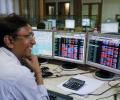
The Sensex jumped 412.23 points on Friday, braving heavy volatility during the day, amid the Reserve Bank of India maintaining status quo on the benchmark lending rate and buying in index heavyweights Reliance Industries Limited and ITC. The BSE Sensex climbed 412.23 points or 0.70 per cent to settle at 59,447.18. During the day, the benchmark hit a high of 59,654.44 and a low 58,876.36. The Nifty also gained 144.80 points or 0.82 per cent to finish at 17,784.35.

Among the Sensex firms, UltraTech Cement, Reliance Industries, ICICI Bank, HDFC Bank, Bharti Airtel, IndusInd Bank, State Bank of India, Tata Consultancy Services, Larsen & Toubro, Kotak Mahindra Bank and State Bank of India were the major gainers. In contrast, Tata Motors, Maruti, Axis Bank, Mahindra & Mahindra, ITC, NTPC, Tata Steel and Bajaj Finserv were the major laggards.
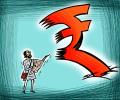
The rupee depreciated 22 paise to a record low of 78.59 against the US dollar in opening trade on Tuesday as persistent foreign funds outflows weighed on investor sentiments. At the interbank foreign exchange, the rupee opened on a weak note at 78.53 against the American dollar, then lost ground to quote at 78.59 -- its all-time low level, registering a fall of 22 paise from the last close. On Monday, the rupee declined by 4 paise to close at its life-time low of 78.37 against the US dollar.

'Valuations of midcaps and smallcaps have reached very high levels, and hence to that extent leave little margin of safety.'
